How to Get Rid of Fungus Gnats in Houseplants
Get rid of fungus gnats fast: dry out the top soil, use yellow sticky traps, bottom water, and apply BTI. A clear, step-by-step plan that actually works.
Those tiny black flies hovering around your plants are fungus gnats, and the fix is less about killing the adults and more about drying out the soil they breed in. Let the top inch or two of soil dry between waterings, add yellow sticky traps to catch the adults, and treat the soil with a BTI product to stop the next generation. Do all three together and most infestations clear in two to four weeks.
Here’s why they show up, and exactly how to get rid of them.
What fungus gnats are (and what they aren’t)
Fungus gnats are small, dark, mosquito-like flies about 1/8 inch (2 to 4 mm) long. You’ll see them walking across the soil surface or flying in weak, drifting loops near your plants, lamps, and windows. They’re annoying but mostly harmless to you and to healthy plants.
The adults don’t do the damage. It’s the larvae, living in the top half-inch to inch of soil, that feed on fungi, decaying matter, and sometimes tender young roots. In a large infestation they can stunt seedlings and cuttings, which is why they’re worth taking seriously even though a single gnat isn’t a crisis.
A quick check so you’re treating the right pest:
- Fungus gnats fly, hang around the soil, and are weak, clumsy fliers.
- Fruit flies are tan or orange and cluster around ripe fruit and drains, not soil.
- Spider mites and mealybugs stay on the plant itself, not the soil. If the trouble is on the leaves, see our guides on spider mites and mealybugs instead.
Why wet soil is the real cause
Fungus gnats need consistently moist soil to complete their life cycle. The females lay eggs in the top layer of damp potting mix, and the larvae need that moisture and the fungi growing in it to survive. Dry that top layer out and you break the chain.
The full cycle runs fast, which is both the problem and the opportunity. Depending on temperature, it takes roughly three to four weeks from egg to adult:
| Stage | Where it lives | Rough duration |
|---|---|---|
| Egg | Top 1/2 inch of moist soil | 3 to 6 days |
| Larva | Top 1 inch of soil | 10 to 14 days |
| Pupa | Soil surface | 3 to 7 days |
| Adult | Flying around plants | up to 1 week |
Because adults only live about a week and the larvae are the breeders-in-waiting, your strategy has to hit two stages at once: trap the adults so they stop laying, and make the soil hostile to eggs and larvae. Kill one stage and ignore the other and the problem just cycles back.
The root cause, almost always, is soil that stays wet too long. That can come from watering on a fixed schedule instead of checking the soil, pots without drainage holes, dense or peat-heavy mixes that hold water, low light and cool temperatures that slow drying, or a pot that’s far too big for the plant. Fix the moisture and you fix the gnats.
The step-by-step plan
1. Let the top of the soil dry out
This is the single most effective thing you can do, and it costs nothing. Let the top 1 to 2 inches of soil dry completely before you water again. Fungus gnat eggs and young larvae can’t survive in dry soil, so a few dry cycles starves the population at its weakest point.
To check, push a finger 2 inches into the soil, or use a wooden chopstick or a cheap moisture meter. Water only when that layer feels dry. For many common houseplants in average indoor conditions, that works out to every 7 to 14 days, but the number matters less than the check. If you’re unsure how to read the difference between dry-but-fine and genuinely thirsty, our guide on how often to water houseplants and the one on overwatering vs underwatering both help.
A few plants can take this even further. Snake plants, pothos, and most succulents are happy to dry out hard, which makes them easy to clear of gnats. Ferns and peace lilies that like steady moisture need more patience and more help from the other steps below.
2. Put up yellow sticky traps
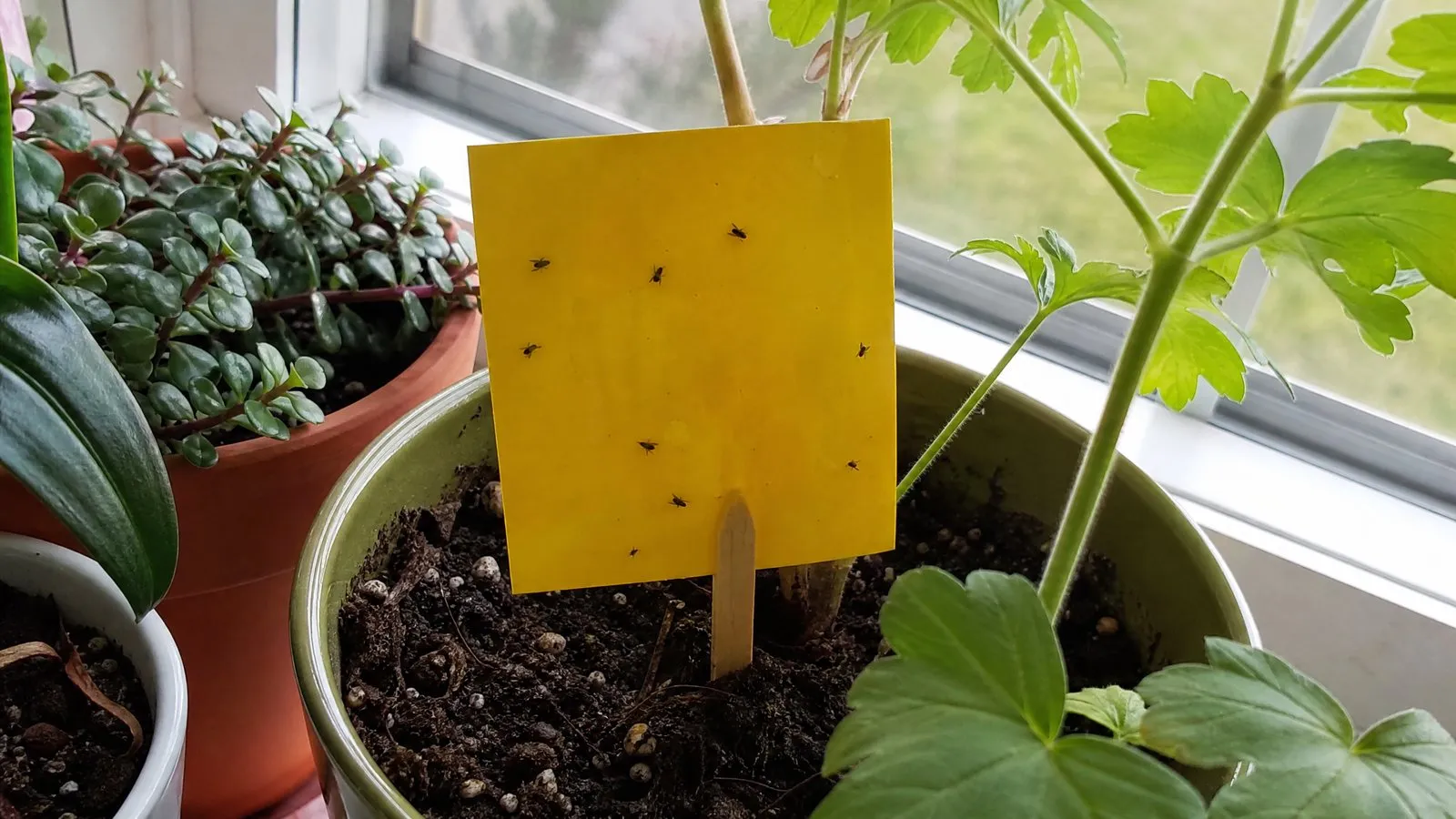
Yellow sticky traps catch adult gnats, which does two things: it removes egg-laying females, and it tells you whether you’re winning. Fewer gnats stuck each week means the treatment is working.
- Lay traps flat on the soil surface or stand them just above it, where the adults walk and hover.
- Use one trap per affected pot, or several spread around a cluster of plants.
- Replace them when they’re covered or lose their stickiness, usually every couple of weeks.
Traps alone won’t end an infestation because they don’t touch the larvae in the soil. But paired with drying and BTI, they speed things up and give you a clear read on progress.
3. Bottom water for a while
Watering from the top keeps the surface layer moist, which is exactly the zone gnats breed in. Bottom watering flips that: the soil draws moisture up from below while the top inch stays drier and less inviting.
To do it, set the pot in a tray or basin with 1 to 2 inches of water, leave it for 15 to 30 minutes until the top of the soil feels just barely damp, then drain it fully. Never leave a pot sitting in water afterward, or you’ll recreate the sogginess you’re trying to avoid. We walk through the details in bottom watering: when it helps and how to do it.
This only works well if your pot has drainage holes. If it doesn’t, that’s a bigger issue than gnats, and how to choose the right pot explains why drainage is non-negotiable.
4. Treat the soil with BTI
BTI is Bacillus thuringiensis subspecies israelensis, a naturally occurring soil bacterium that kills fungus gnat larvae when they eat it, while leaving people, pets, and plants alone. University extension programs, including Colorado State University Extension, recommend BTI as a targeted biological control for fungus gnats. You’ll find it sold as mosquito control granules or “dunks” and as liquid soil drenches labeled for fungus gnats.
The practical catch is that BTI only affects larvae currently in the soil, and it breaks down over days. Because new eggs keep hatching, you need to reapply to catch each wave:
- Follow the product label exactly for dilution and frequency. Labels vary, and the label is the legal and safe instruction.
- Granular “dunk” types are often crumbled over the soil or steeped in your watering can; liquid types are mixed into water and used as a drench.
- Plan to repeat every time you water, or as the label directs, for about 3 to 4 weeks so you cover the full life cycle.
Keep any BTI product in its original container, away from children and pets, and don’t improvise doses. When a label and a tip online disagree, the label wins.
5. Top-dress the soil surface
A dry barrier on top of the soil makes it hard for adults to lay eggs and for new adults to climb out. Add a 1/4 to 1/2 inch layer of a fast-drying material over the potting mix:
- Horticultural grit, coarse sand, or fine gravel
- Pumice or perlite
- Specialty mineral top-dressings sold for this purpose
The layer works because it dries out almost immediately after watering, so the egg-laying zone the gnats depend on simply isn’t there anymore. It pairs especially well with bottom watering, since you’re wetting from below and keeping the cap dry.
Prevent the next outbreak
Don’t over-pot
A pot that’s much bigger than the root ball holds a reservoir of wet soil the roots can’t use, and that slow-drying mass is a fungus gnat paradise. When you repot, go up just 1 to 2 inches in diameter, no more. Our guide on how to repot a houseplant without killing it covers sizing, and how to choose the right pot explains why bigger isn’t better.
Use a mix that drains
Dense, water-retentive potting mixes stay wet longer and invite gnats. A mix amended with perlite, pumice, or bark drains faster and dries at the top more readily. See potting soil for houseplants for what to use and how to improve a bagged mix.
Fresh bagged potting soil can also arrive already carrying gnat eggs. Storing opened bags sealed and dry, and not reusing old soggy soil, cuts the risk.
Quarantine and inspect new plants
New plants are the most common way gnats enter a home. Keep a new plant separate for a week or two, watch the soil surface for walking gnats, and pop a sticky trap in the pot as an early warning before moving it in with the rest.
Water on evidence, not habit
The through-line of this whole guide is simple: check the soil and water when it’s actually dry, not on a set day. That single habit prevents fungus gnats, root rot, and a long list of other problems. If you want help building a flexible rhythm, our watering planner and the beginner overview in the 5 things that matter most are good starting points.
How long it takes and what to expect
Give it time to match the life cycle. You’ll usually see adult numbers drop within the first week of trapping and drying, but because eggs keep hatching, full control takes about three to four weeks of consistent treatment. If you stop early, the survivors rebound.
If gnats persist past a month despite drying the soil, trapping adults, and reapplying BTI, something is keeping the soil wet: a pot without drainage, a too-large pot, a chronically soggy mix, or a very low-light spot where soil never dries. Fix the moisture source and the gnats follow.
For a bad, established infestation, you can combine everything above with a full repot: gently remove most of the old soil, rinse loose material from the roots, and replant in fresh fast-draining mix in an appropriately sized pot. That resets the breeding ground in one move.
When to call for help
Fungus gnats are a nuisance, not a health hazard, and you can handle them at home. But read the label on any product you use, and if you have respiratory concerns, young children, or pets in the home, follow the label’s safety directions closely. If you ever suspect a pet has eaten a treated product or a plant, contact your veterinarian or a poison control service right away. For which plants are pet-safe in the first place, see houseplants safe for cats and dogs.
FAQ
Will fungus gnats kill my plant?
Usually not. The adults are harmless, and a light infestation does little to an established plant. Heavy larvae populations can damage the roots of seedlings, cuttings, and young plants, so treat those sooner. For most mature houseplants, gnats are more annoyance than threat.
Do I need to repot to get rid of them?
Not always. Drying the top soil, using sticky traps, bottom watering, and applying BTI clears most infestations without repotting. Repot only if the soil stays stubbornly wet, the pot is oversized or lacks drainage, or the infestation is severe and you want a full reset with fresh, fast-draining mix.
Are the gnats coming from my new bag of potting soil?
They can be. Bagged soil sometimes carries fungus gnat eggs, especially if it’s been stored damp. Keep opened bags sealed and dry, and quarantine new plants and fresh soil for a week or two with a sticky trap as an early warning before adding them to your collection.
Is BTI safe to use around pets and kids?
BTI targets specific insect larvae and is widely regarded as low-risk to people, pets, and plants when used as directed. That said, every product is different, so follow the label for dosing, storage, and safety, keep it out of reach of children and pets, and contact a vet or poison control if a pet ingests a treated product.
Can I just let the soil dry out and skip everything else?
Drying is the most important step, and for drought-tolerant plants like snake plants and pothos it can be nearly enough on its own. But sticky traps and BTI speed things up and catch the adults and larvae you’d otherwise wait out. For moisture-loving plants that can’t dry hard, you’ll need the full combination.
A note on health information: Our guides are general advice for common houseplants and edible plants grown indoors. Some popular houseplants are toxic to pets and children if eaten — check before bringing a new plant home. When using any pest treatment, follow the product label and keep it away from children and pets.