How to Choose the Right Pot (Size, Material and Drainage)
Pick the right pot for your houseplant: why drainage holes matter, terracotta vs plastic vs ceramic, sizing up only 1-2 inches, and using cachepots safely.
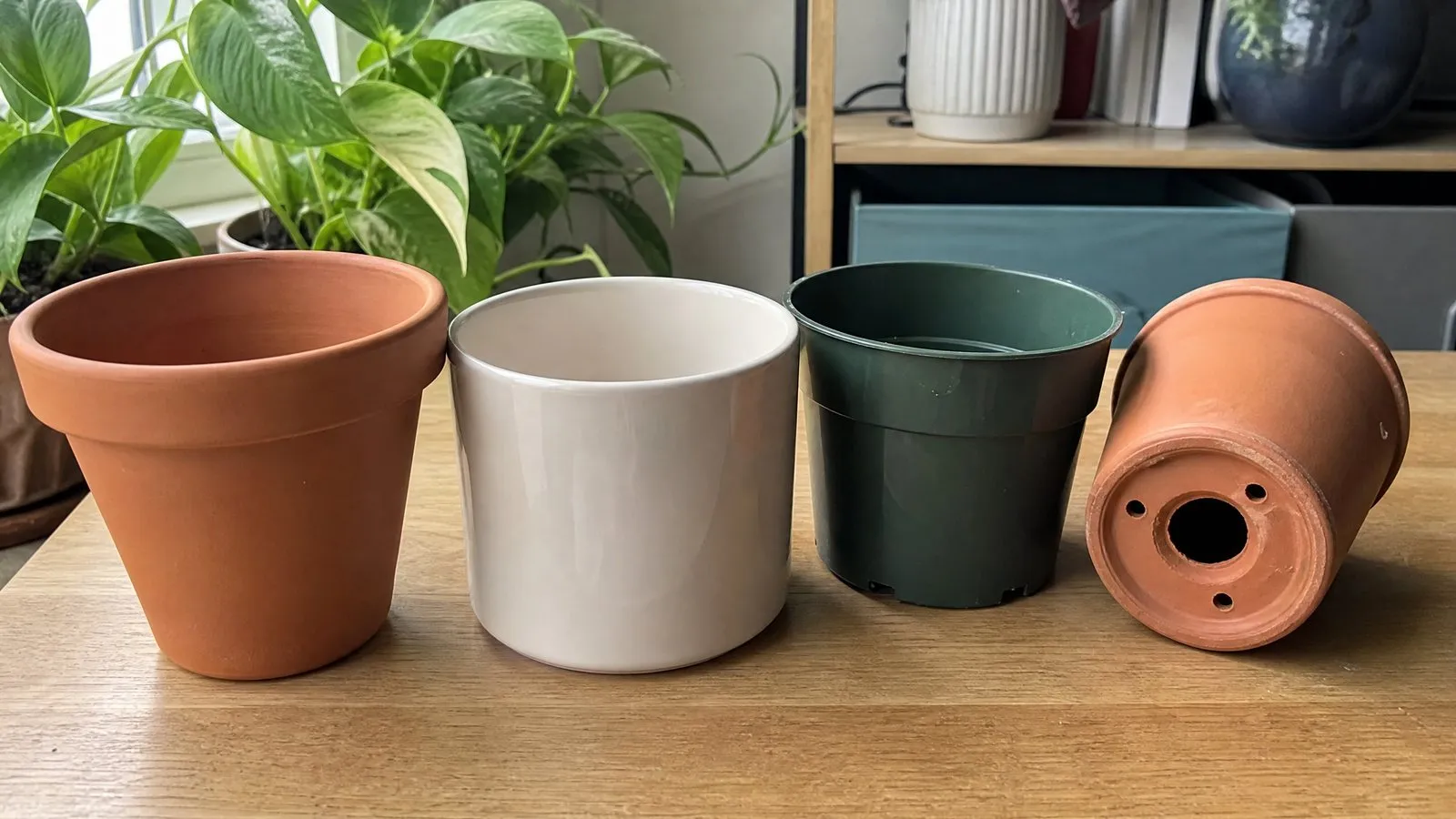
The single most important feature of any pot is a drainage hole. Everything else—material, color, price—matters less than whether water can escape the bottom. Start there, size up only 1-2 inches when you repot, and pick a material that matches how often you tend to water, and you’ll avoid the most common way people kill plants.
Here’s how to make that choice with confidence.
Why drainage holes matter more than anything
When you water a potted plant, gravity pulls the water down. If there’s a hole, the excess drains away and air flows back into the soil within a minute or two. If there’s no hole, that water pools at the bottom in a zone you can’t see and can’t easily dry out.
Roots sitting in soggy soil can’t breathe. Within days they start to suffocate and rot, and rotting roots can’t take up water—so the plant wilts even though the soil is wet. This is the overwatering trap, and a pot with no drainage makes it almost guaranteed. (If your plant is drooping in damp soil, see Overwatering vs Underwatering: How to Tell the Difference.)
University extension programs, including Penn State Extension, consistently point to drainage as a basic requirement for healthy container plants. The advice is simple: buy pots with holes. If you fall in love with a pot that has none, use it as a decorative outer cover (a cachepot) around a plastic grow pot that does drain. More on that below.
One old myth worth dropping: a layer of gravel or pot shards at the bottom does not improve drainage. It actually raises the waterlogged zone closer to the roots. Skip the gravel and use a pot with a hole instead.
Pot material: how each one changes your watering
The material your pot is made of changes how fast the soil dries out. That’s the practical difference, and it should match your habits and your plant.
Terracotta (unglazed clay)
Terracotta is porous. Water evaporates through the walls as well as the top, so soil dries faster—often a few days sooner than the same plant in plastic.
- Best for: plants that like to dry out, like snake plants, succulents, cacti, and most herbs. Also great if you’re a chronic overwaterer.
- Watch out for: it dries fast, so thirsty plants in a sunny, warm room may need water more often. Terracotta can also crack if it freezes, which matters on cold balconies and windowsills.
- Bonus: the heavy clay base resists tipping for tall, top-heavy plants.
If you tend to love your plants to death with the watering can, terracotta is forgiving. See Snake Plant Care for a plant that pairs perfectly with it.
Plastic (and resin)
Plastic is non-porous, so soil stays moist longer. It’s lightweight, cheap, and usually comes with drainage holes already in place.
- Best for: moisture-loving plants like peace lilies, ferns, and calatheas, and for anyone who forgets to water.
- Watch out for: it holds water, so it’s easier to overwater. Lightweight pots can tip over under a big plant.
- Bonus: nursery pots are easy to lift out for bottom watering and to check roots.
Most plants arrive from the shop in a thin plastic nursery pot. That pot works fine—you can simply drop it inside a prettier cachepot and skip repotting for now.
Glazed ceramic
Glazed ceramic sits in the middle. The glaze seals the clay, so it holds moisture more like plastic than terracotta, but it’s heavier and often better looking.
- Best for: most houseplants, especially as a decorative pot that still has a drainage hole.
- Watch out for: many decorative ceramic pots have no hole. Check before you buy, or plan to use it as a cachepot.
- Bonus: the weight keeps tall plants stable, and it won’t dry out as brutally fast as terracotta.
Quick comparison
| Material | Dries out | Weight | Drainage holes | Best match |
|---|---|---|---|---|
| Terracotta | Fast | Heavy | Usually yes | Succulents, cacti, herbs, overwaterers |
| Plastic | Slow | Light | Usually yes | Ferns, peace lilies, forgetful waterers |
| Glazed ceramic | Medium–slow | Heavy | Often no—check | Most plants; decorative use |
Whatever you choose, remember the pot is only half the equation. The soil inside it controls drainage too—see Potting Soil for Houseplants.
Size up only 1-2 inches at a time
When you repot, go up just 1-2 inches in diameter from the current pot. For a plant in a 4-inch pot, move to a 5- or 6-inch. For a 6-inch plant, move to an 8-inch. Floor plants in large pots can jump 2-3 inches, but the principle holds: a small step up, not a big one.
It’s tempting to “give the plant room to grow” by putting a small plant in a big pot. Don’t. A large pot holds a large volume of soil, and the roots can’t drink it fast enough. The extra soil stays wet for days, and that’s exactly the soggy condition that rots roots. A snugly sized pot dries at a healthy pace and keeps the roots happy.
Signs your plant actually needs a bigger pot:
- Roots growing out of the drainage hole
- Roots circling the surface or visibly packed when you slide the plant out
- Water runs straight through without soaking in
- The plant dries out within a day or two of watering, every time
If none of those apply, leave it be. Many plants are perfectly happy staying in the same pot for a year or more. When it is time, our step-by-step guide walks you through it: How to Repot a Houseplant Without Killing It.
Matching pot size to plant
- 4-inch pot: small starts, young pothos, herbs, propagations
- 6-inch pot: most medium tabletop plants
- 8-10 inch pot: large tabletop or small floor plants, mature monsteras
- 12-inch and up: big floor plants and trees
Cachepots: how to use decorative pots safely
A cachepot is a decorative outer pot with no drainage hole. You keep your plant in its plain plastic nursery pot (which does drain) and set that inside the pretty cachepot. This is the best of both worlds: the look you want, the drainage your plant needs.
The one rule: don’t let the inner pot sit in standing water.
How to water safely with a cachepot:
- Lift the inner nursery pot out and water it over a sink, or water it in place.
- Let it drain fully for 5-10 minutes.
- Pour out any water that has collected in the bottom of the cachepot before setting the plant back in.
If you can’t easily lift the inner pot, drop a small saucer, a few pebbles, or a cork trivet into the bottom of the cachepot. That raises the nursery pot above any drained water so the roots never sit in it. Check it after each watering for the first few weeks until you know how much your plant drinks.
Cachepots are also the fix for that gorgeous ceramic pot with no hole. Don’t plant directly into it—use it as a cover.
Self-watering pots: pros and cons
Self-watering pots have a reservoir in the base. Water wicks up into the soil as the plant needs it, so you refill the reservoir every week or two instead of watering from the top daily.
They can be genuinely useful, but they’re not right for every plant.
Pros
- Fewer waterings—handy for busy people and for trips (see How to Keep Plants Watered While You’re on Vacation)
- Steady, even moisture, which plants like peace lilies, ferns, and many herbs appreciate
- Less feast-or-famine than forgetting then overcompensating
Cons
- Bad for plants that like to dry out. Succulents, cacti, and snake plants can rot in constant moisture.
- You need to let the reservoir run empty occasionally so the soil isn’t permanently saturated.
- The roots must reach the reservoir wick to benefit, so they work best once a plant is established, not for fresh cuttings.
- They can encourage fungus gnats if the top soil stays damp (see How to Get Rid of Fungus Gnats).
A good rule: use self-watering pots for moisture-lovers, and stick with terracotta or well-draining pots for anything that likes to dry between waterings. And no matter the pot, let the plant tell you when it’s thirsty rather than following a fixed calendar—our Watering Planner and the guide How Often Should You Water Houseplants? both lean on checking the soil instead.
A simple way to decide
Put it together like this:
- Does it have a drainage hole? If not, it’s a cachepot, not a planting pot.
- How’s your watering habit? Overwaterer: terracotta. Forgetful: plastic or self-watering. In between: glazed ceramic.
- What does the plant want? Dries-out lovers (succulents, cacti, snake plants) lean terracotta. Moisture lovers (ferns, peace lilies, herbs) lean plastic or self-watering.
- How big? Up just 1-2 inches from the current pot.
Get those four right and the pot stops being a risk and starts doing its job. If you’re still building the basics, Houseplant Care for Beginners: The 5 Things That Matter Most ties watering, light, and potting together.
FAQ
Can I drill a drainage hole in a pot that doesn’t have one?
Yes, for many ceramic and plastic pots. Use a masonry or diamond-tipped bit for ceramic, go slow, and keep the surface wet to reduce cracking and dust. Thin plastic is easy; thick stoneware can crack, so if the pot is precious, use it as a cachepot instead.
Do I need a saucer under my pot?
If the pot has a drainage hole and sits on furniture or a floor you care about, yes—a saucer catches runoff. Empty it within 30 minutes of watering so the pot isn’t sitting in water. A cachepot can double as a saucer as long as you pour out the collected water.
How do I stop soil falling out of the drainage hole?
Lay a piece of mesh, a coffee filter, or a scrap of landscape fabric over the hole before adding soil. It lets water through while holding the soil in. Avoid using gravel for this—it doesn’t help drainage and takes up root space.
Is terracotta or plastic better for beginners?
If you tend to overwater, terracotta is more forgiving because it dries faster. If you tend to forget, plastic holds moisture longer and buys you time. Match the pot to your honest habit, not the one you wish you had.
How often should I repot into a bigger size?
Most houseplants need sizing up every 1-2 years, but go by the plant, not the calendar. Repot when you see roots escaping the drainage hole, circling the root ball, or water running straight through. Otherwise, refreshing the top inch or two of soil is often enough.